





Firstly, let’s understand the key stakeholders mentioned:
- Owners Corporation = made up of all Lot Owners of the building, responsible for all common property.
- Committee of Management (the Committee) = elected volunteers made up of Owners (or their proxy holder) at the building. Acts on behalf of the Owners Corporation.
- Owners Corporation Manager = The Knight (appointed by the Owners Corporation to carry out decisions made by the Committee/Owners Corporation)
RELATED – A simple Guide to OC Resolutions
What are Owners Corporation (OC) Fees?
Owners Corporation (OC) fees, also known as levies, are your share of the operational and administrative expenses incurred by your Owners Corporation. You are legally required to pay these fees as a member of the Owners Corporation, which you automatically become when you purchase your lot.
Each year, the Committee prepares a budget that factors in ongoing costs such as maintenance, cleaning, insurance, utilities, building management and Owners Corporation management. This budget is then approved by all owners at the Annual General Meeting (AGM).
Your levies represent your portion of this overall budget and ensure that costs are shared equitably between all owners.
In most cases, your appointed Owners Corporation Manager (that’s us) will issue your fee notice on behalf of the Owners Corporation. This can sometimes cause confusion, so it’s helpful to note that:
- The manager does not set the fees: your levies are determined by the budget approved by all owners at the AGM
- Payments are not made to the manager: they are deposited into a bank account held specifically for your building
- The manager’s fee represents only a portion of the total levies: the majority covers day‑to‑day operating and maintenance costs
While payment of levies is a legal obligation, they are also an important investment in the upkeep and management of your property and help protect the long‑term value of your asset.
How can I know if my fees will increase?
Prior to your AGM each year, you will receive an AGM pack which includes an agenda for the meeting, and the proposed budget to be adopted for the coming year.
This budget will reveal the increases which will apply to your fees, if the budget is adopted.
This is why attending the AGM is so important: it provides an opportunity to understand and discuss the budget with your fellow owners, so you can feel confident in what your fees are covering.
The Committee are actively involved in setting this budget, adding, amending and removing items, and seeking new providers and contracts to control overall expenditure. If you are passionate about this, you can nominate to join your committee and help with this process.
Important: remember that low fees are not necessarily a good thing. If they are achieved by avoiding or reducing important maintenance & upkeep, this is likely to both increase costs in the long run and negatively impact the value & safety of your building.
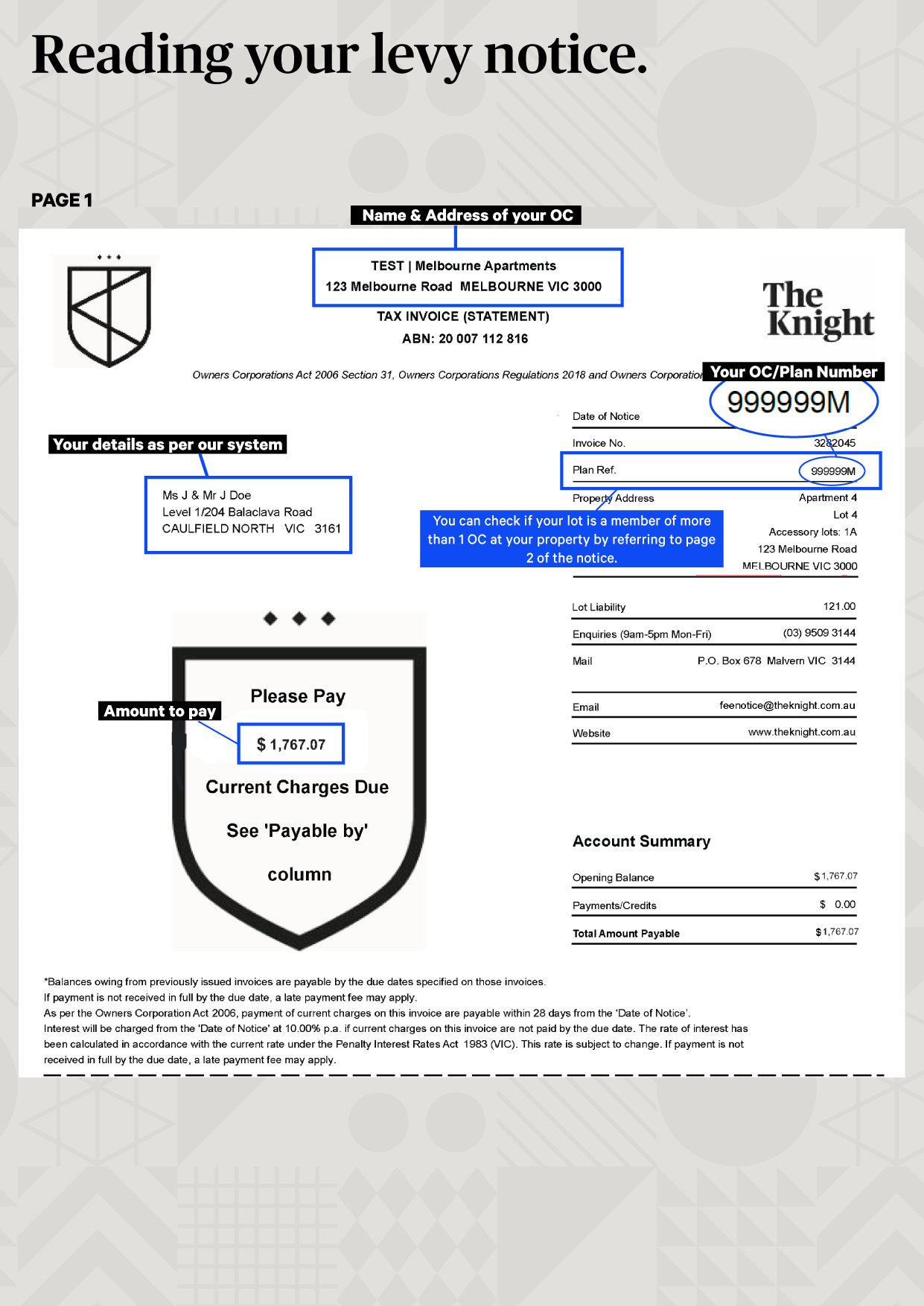
What is my OC Fee Notice or Levy Notice?
Your Fee Notice is issued at regular intervals (usually quarterly, though this may vary) and outlines:
- The date of the notice
- The period the fees relate to
- The Owners Corporation the fees are for
- The portion of fees allocated to Administration (ongoing costs) and Maintenance (funds set aside for future expenses)
- The date payment is due
Typically, levies are due 28 days from the date of the notice.
If payment is not received by the due date, a reminder will be issued. If payment is still not received after a further 28 days, debt recovery and/or legal action may be initiated.
If payment is not made by the due date, interest may accrue on the outstanding balance, along with additional costs as follow‑up action progresses.
If you know you will be unable to make payment by the due date, it is best to contact your Owners Corporation Manager as early as possible to discuss what options are available.
Where do I find my OC Fee Notice?
When you first moved in, you provided your preferred contact details and methods. Based on this, you will either receive your fee notice by email or in the post.
It is your responsibility to ensure these details are correct: the due date of your levies remains the same, even if you have not received the notice. You can update these details here.
If you are worried you have missed or lost your Fee Notice, the quickest and easiest way to secure a copy is via the My Property portal. You can access this anytime, anywhere, with no need to contact anyone.
3 quick steps to access My Property:
- Jot down your OC Plan Number
- Enter it on this page
- Click ‘Get Started Now’ and fill out the registration form
Otherwise, you can email [email protected] to request a copy be sent to you.
How do I pay my OC Fees?
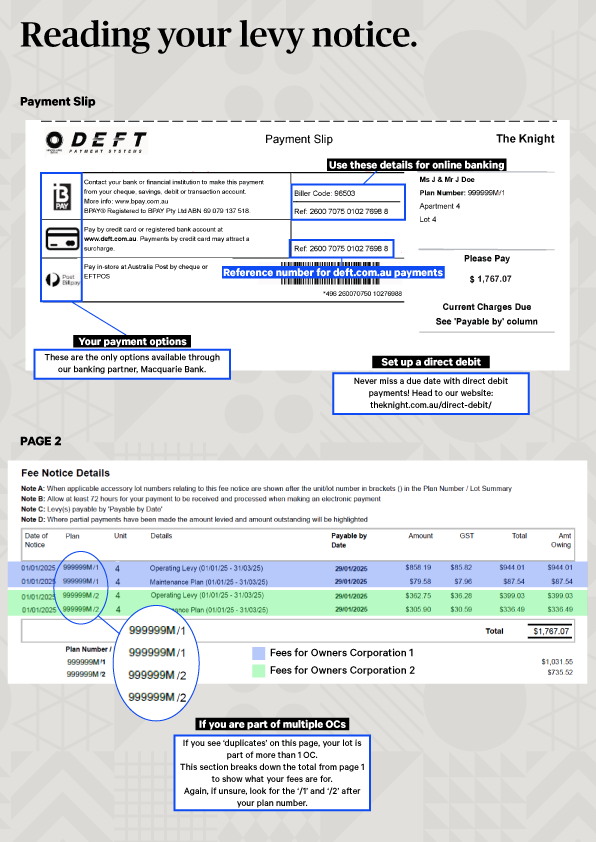
Multiple payment options are outlined on your Fee Notice. You can
- make payments via BPAY through your bank
- pay online at deft.com.au using a credit card
- pay in person at Australia Post using Post Billpay.
The benefits of Direct Debit payments.
Alternatively, you can set up direct debit. This allows your fees to be automatically deducted from your nominated account three days prior to the due date.
Many owners choose this option to avoid missing a fee notice or forgetting to make a payment. It also helps ensure payments are made on time, avoiding any additional charges associated with late payment.
Register for Direct Debit payment of fees >
What is a ‘Special Levy’?
Your regular levies cover your share of the annual budget, which includes expected administrative expenses and planned maintenance costs. However, unexpected costs can sometimes arise.
If there is a significant shortfall in funds and an expense needs to be covered, an Owners Corporation has the power to raise what is known as a Special Levy.
A Special Levy is a one‑off fee, charged in addition to your regular levies, to cover a specific expense.
At The Knight, our aim is to support Owners Corporations to prepare robust and comprehensive annual budgets to reduce the likelihood of a Special Levy being required. That said, each Owners Corporation is different, and decisions about fees ultimately rest with the Committee and Owners.
What is an ‘Adjustment Levy’?
Each year, the budget is approved at the Annual General Meeting (AGM). Until that happens, levies continue to be charged at last year’s rate.
If the new budget is higher and the first quarter’s levies have already been collected, an extra charge is needed to make up the difference.
This extra charge is called an adjustment levy. It may be issued as a separate charge or included with the second quarter’s levies.
When an adjustment levy is struck, you will receive a letter explaining it, so be sure to read through this, before reaching out to your Manager if you still have questions.
What support is available if I’m struggling to pay my fees?
There are several options that may be available. If you are unable to make payment by the due date, you can request an extension. If approved, this may help you avoid many of the additional charges outlined above, provided payment is made by the newly agreed date.
You may also request a payment plan to pay the outstanding balance in instalments. It is important to note, however, that an Owners Corporation is not obliged to approve payment plan requests. Your Committee of Management will review all requests and provide an outcome.
OC fees fund the day‑to‑day running of the building, and Owners Corporation budgets are often very lean, with funds collected each cycle intended to cover current expenses. If too many payments are late or reduced, this can impact the Owners Corporation’s ability to pay its bills, including essential services that residents rely on.
Important: A payment plan only applies to outstanding amounts. Future levies will continue to be issued as normal, so these upcoming costs should be factored into any request you make.
If you’re feeling overwhelmed and need help to deal with financial issues, you can get free, independent, and confidential advice from a community-based financial counsellor. To speak to a financial counsellor, call the National Debt Helpline on 1800 007 007 or visit the National Debt Helpline’s find a financial counsellor page to find a financial counsellor near you.
Submit a Fee Support Request >
This article is for reference purposes only and is not intended to be a comprehensive review of the developments in the law and practice or to cover all aspects of the subject matter. It does not constitute legal or other advice and should not be relied upon this way. Readers should take legal or other advice before applying the information containing in this publication.